
Last updated October 15, 2026
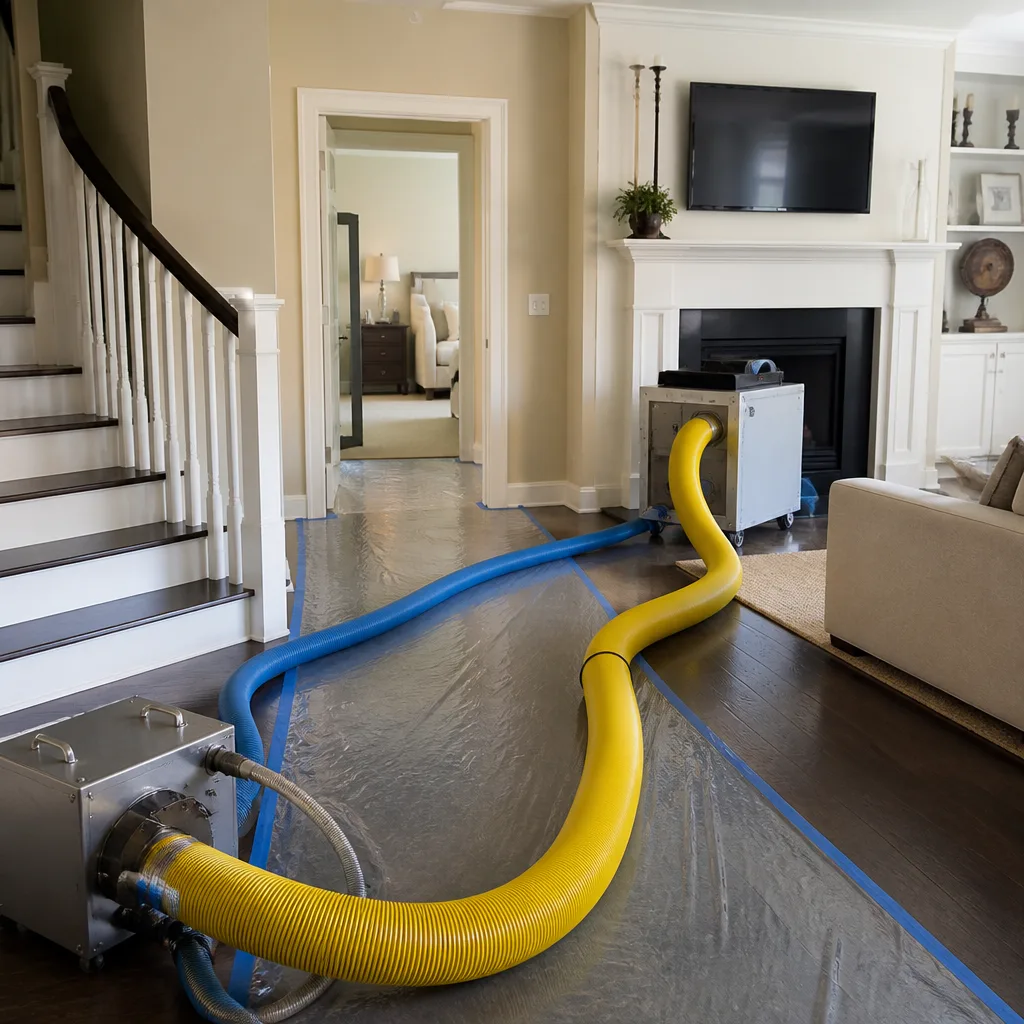 Whole-home duct cleaning
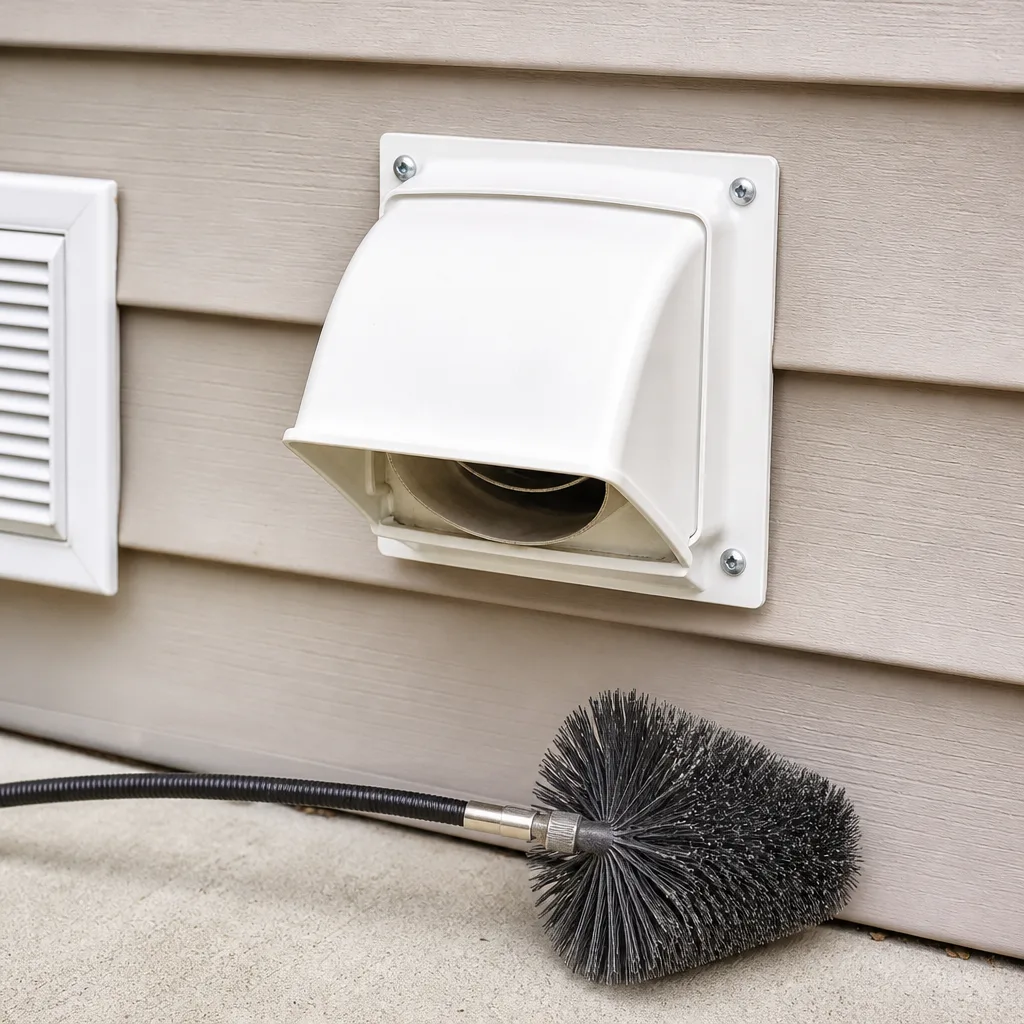 Dryer vent cleaning
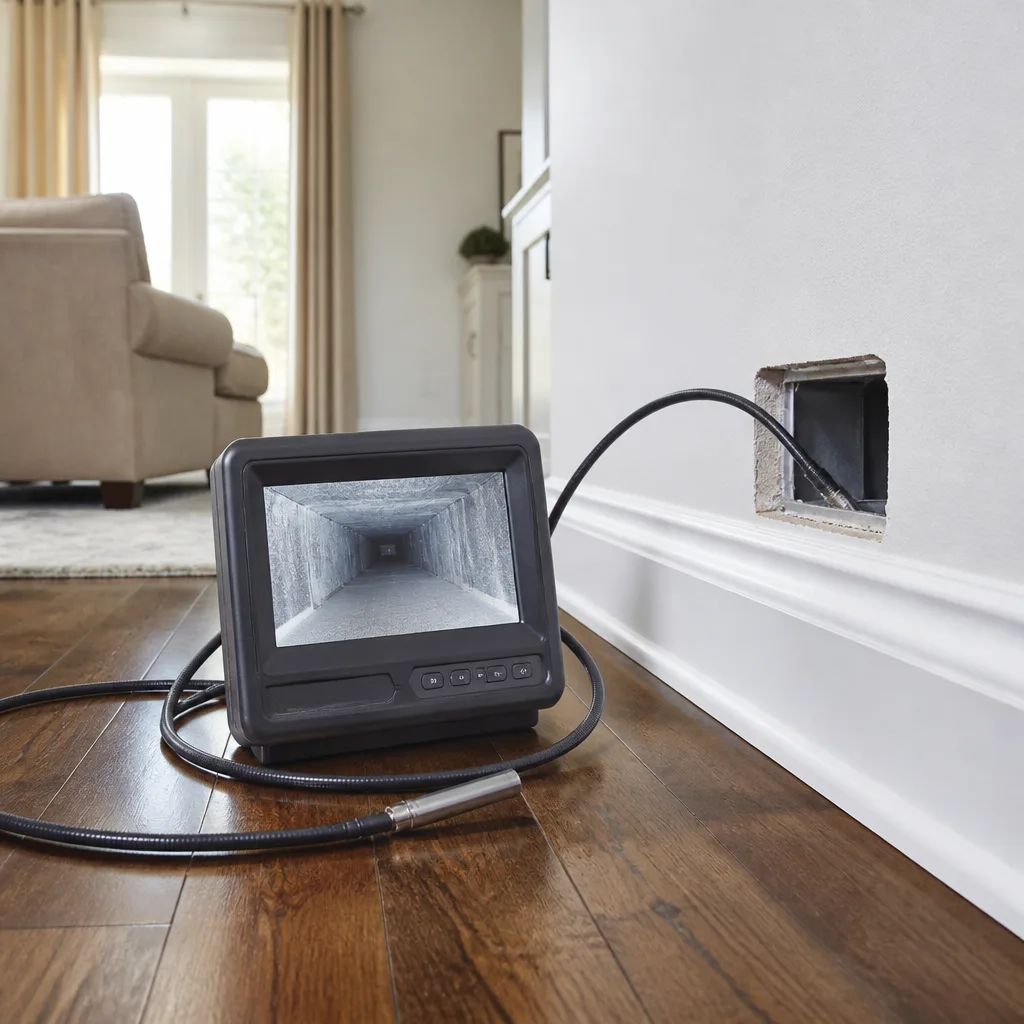 Camera inspection
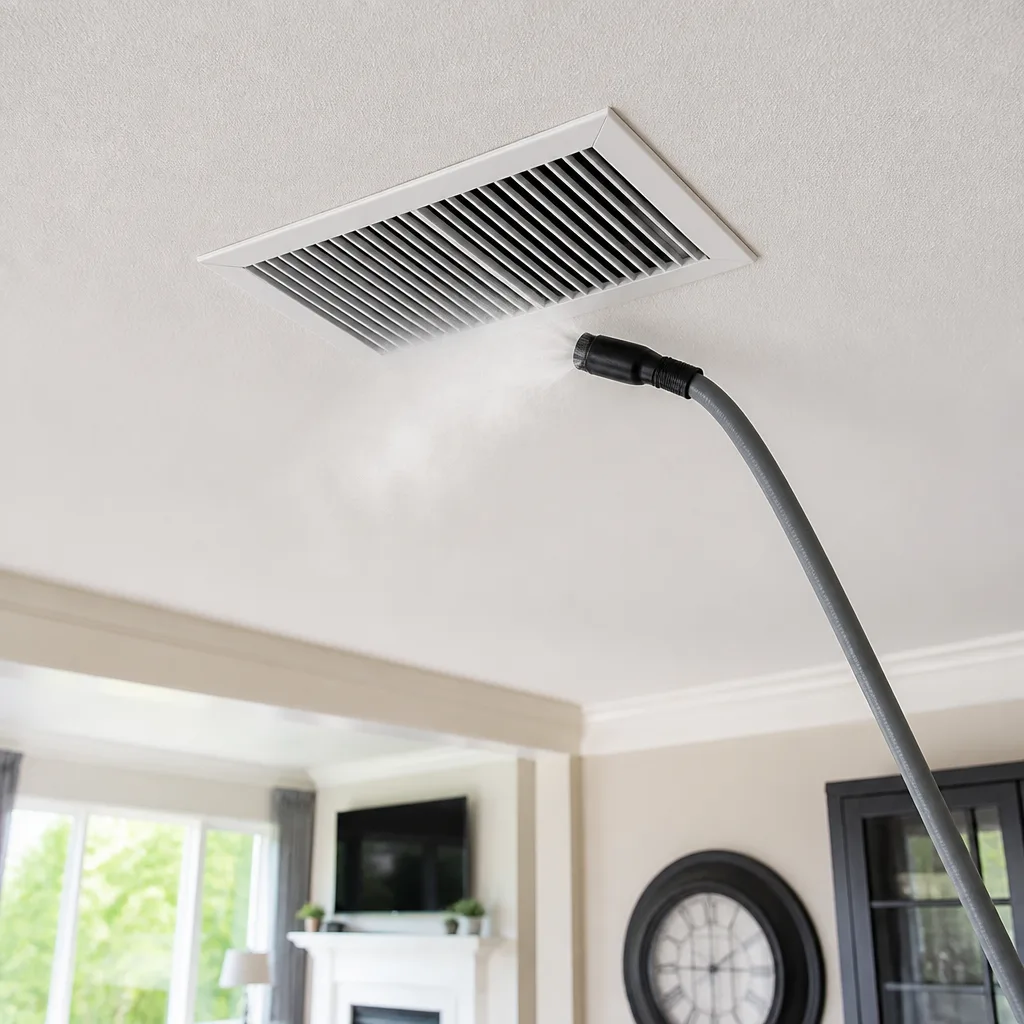 Sanitizing & deodorizing
Whole-system duct and dryer vent check with before-and-after photos - you see exactly what came out of your vents
That "$99 whole-house special" is a bait ad - the real number appears once they are in your hallway, or the "clean" is a shop-vac at the register. We photograph the inside of your ducts before and after instead.
DIY vs Professional Air Duct Cleaning: The Pasadena Homeowner’s Decision Guide
A $30 brush kit from the hardware store will clean the first 18 inches of your supply duct. Everything beyond that requires equipment that costs more than your HVAC system. That’s not marketing spin – it’s physics. The average Pasadena home has 30 to 60 linear feet of ductwork snaking through attics, crawl spaces, and wall cavities. Most of it sits behind drywall where no homeowner’s arm, shop vac hose, or good intention can reach. This guide maps exactly where DIY duct cleaning still makes sense, where it stops working, and how to spend your money where it actually changes the air you breathe in Pasadena. For a deeper look at professional solutions, see our Air Duct Cleaning service page.
Styles & brands we work with
Quick Answer
DIY duct cleaning is genuinely useful for registers, grilles, and the first few feet of accessible ductwork – about 15% of your system – but it cannot reach the main trunk lines where dust, debris, and allergens actually accumulate. Professional air duct cleaning in Pasadena uses negative-air machines and rotary brush systems that create suction and agitation far beyond any shop vac, typically costing $400 – $900 for an average home depending on size and system condition. The smartest approach for most Pasadena homeowners combines both: DIY register maintenance year-round, professional cleaning every 3 – 5 years. For related advice, check out our Seasonal Air Duct Cleaning Care for Pasadena: Year-Round Homeowner’s Guide.
Table of Contents
- What DIY Can Actually Clean (And How to Do It Right)
- Where DIY Stops: The Physics of Deep Ductwork
- The Equipment Professionals Use (And What It Costs)
- Honest Cost Comparison: DIY vs Professional in Pasadena
- When DIY Is Genuinely Enough
- When DIY Makes the Problem Worse
- The Combined Approach: DIY Between Professional Cleanings
- Common Mistakes to Avoid
- When to Call a Professional
- Frequently Asked Questions
- The Bottom Line
What DIY Can Actually Clean (And How to Do It Right)
Let’s be precise about what a homeowner can effectively clean without spending money on professional equipment. The reachable parts of your duct system are: supply and return registers, the grille boxes behind them, and the first 12 – 24 inches of visible ductwork where it connects to those registers. In most Pasadena homes – whether you’re in a 1920s bungalow in Bungalow Heaven, a mid-century ranch in Hastings Ranch, or a 1980s build in the San Rafael Hills – that’s roughly 15% of the total system.
Here’s the straightforward method that actually works:
- Turn off the HVAC system at the thermostat and the breaker box. You don’t want the blower pulling debris deeper into the system while you work.
- Remove each register cover by unscrewing it from the wall or floor. Soak metal covers in warm, soapy water. Wipe wood or decorative covers with a damp cloth.
- Vacuum the visible duct opening using a shop vac with a long hose attachment. Reach in as far as the hose will go – typically 12 – 24 inches. Use a soft brush attachment to knock dust loose from the duct walls before vacuuming.
- Wipe the register box interior with a damp microfiber cloth. This is where hair, dust bunnies, and small debris collect in every home.
- Replace the register cover once dry, and move to the next one. Most homes have 8 – 14 registers total.
This takes 60 – 90 minutes in a typical Pasadena house and costs almost nothing. It removes the visible dust you see on register covers and the first stretch of duct interior. What it does not do is touch the main trunk line running through your attic or crawl space, the branch lines behind walls, or the return air plenum where the real accumulation happens. That’s not a failure of effort – it’s a limitation of reach.
In our experience cleaning ducts across Pasadena, we’ve seen register-level maintenance keep systems visibly cleaner for months at a time. Homeowners who do this twice a year – spring and fall, when Pasadena’s Santa Ana winds kick up dust and the foothill areas see heavier particulates – genuinely extend the time between professional cleanings.
Where DIY Stops: The Physics of Deep Ductwork
Your HVAC system moves air through a network shaped like a tree. The trunk line runs from the air handler, branching into smaller lines that terminate at registers in each room. In a 2,000-square-foot Pasadena home, that’s often 40 – 60 linear feet of ductwork, most of it running through unconditioned attic space that hits 120°F on summer afternoons or through crawl spaces with their own dust and humidity cycles.
The problem isn’t that DIY tools are bad. A standard 5-horsepower shop vac produces about 100 – 150 CFM (cubic feet per minute) of airflow. A professional negative-air machine from a company like Nikro produces 2,000 – 5,000 CFM. That’s a 15 – 30x difference in suction power, and it matters because of how dust behaves in ductwork.
Dust inside a main trunk line doesn’t sit loosely on the bottom in a neat pile. It coats the interior surfaces, trapped against the metal or flex-duct walls by static charge, humidity cycles, and the constant push of airflow. Removing it requires two things working together: powerful negative pressure pulling the full length of the duct, and mechanical agitation dislodging the adhered layer. A brush on a wet-dry vac agitates the first couple feet and moves dust around beyond that range – it does not remove contamination from the trunk line itself.
Here’s what that means in practical terms for a Pasadena homeowner:
- A shop vac reaches 1.5 – 2 feet per register. The remaining 30 – 50 feet of main trunk and branch lines stay untouched.
- Vacuuming only from register openings can dislodge dust without capturing it. That dust settles back down inside the duct within hours, or worse, re-enters the living space when the blower kicks on.
- Return-air sides are almost never accessible from inside the living space. The return plenum and filter housing often sit in the attic or a closet, connected to the wall return grille by 8 – 15 feet of duct that no household tool reaches.
Pasadena’s climate makes this worse than in milder coastal towns. Our summers push 100°F, and the temperature swings between attic heat and air-conditioned interior cause condensation cycles inside unconditioned ducts. Dust that gets damp and dries repeatedly bonds to duct surfaces. The fine particulate matter from wildfire season – increasingly common in the San Gabriel Valley – travels through unconditioned attic ductwork and adheres the same way. A shop vac will not remove this adhered layer, no matter how determined the operator.
The Equipment Professionals Use (And What It Costs)
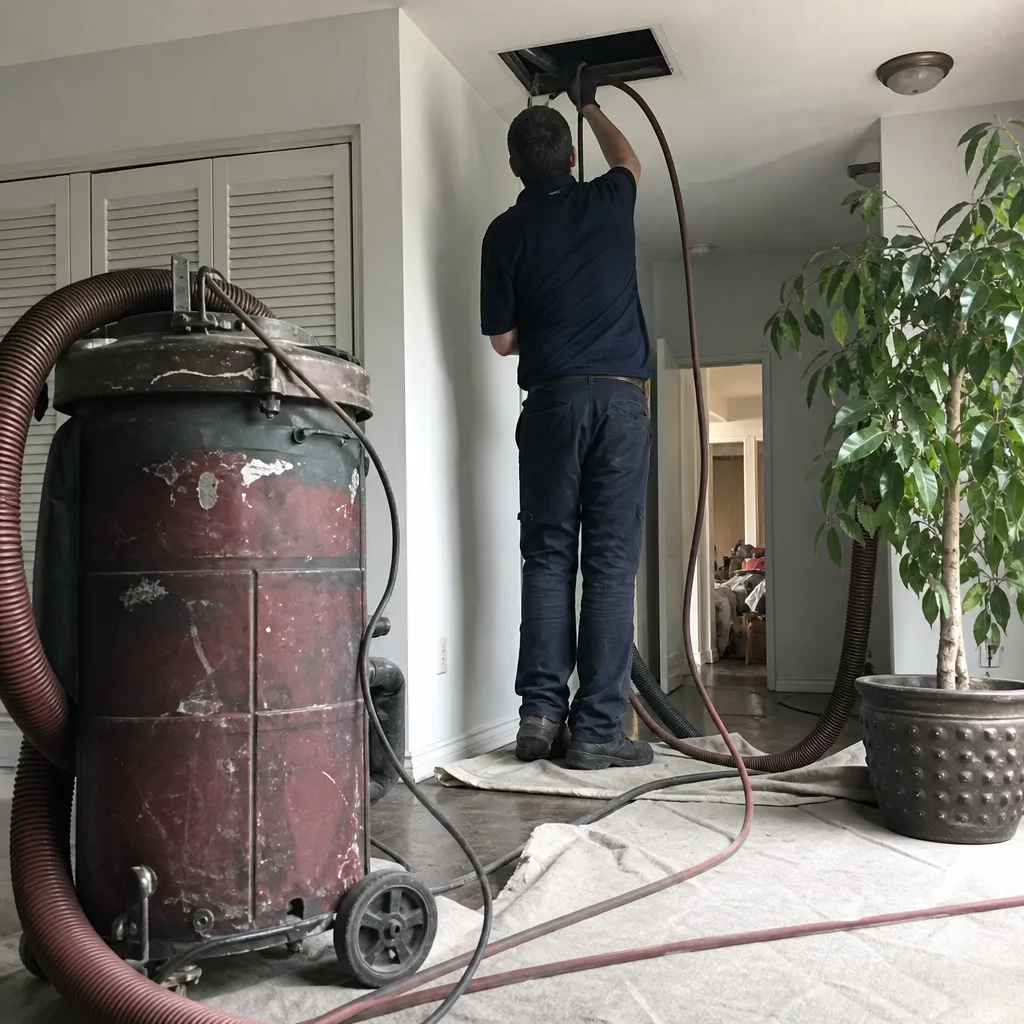
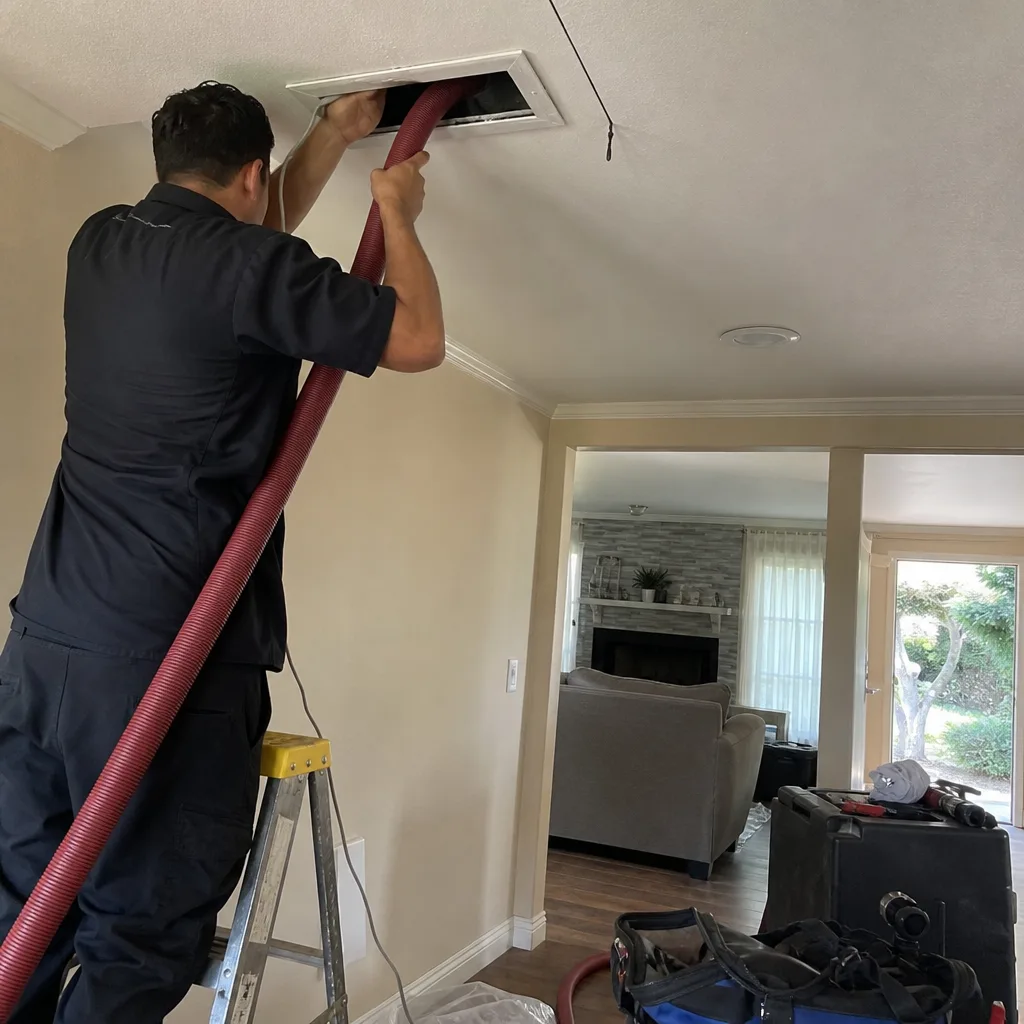
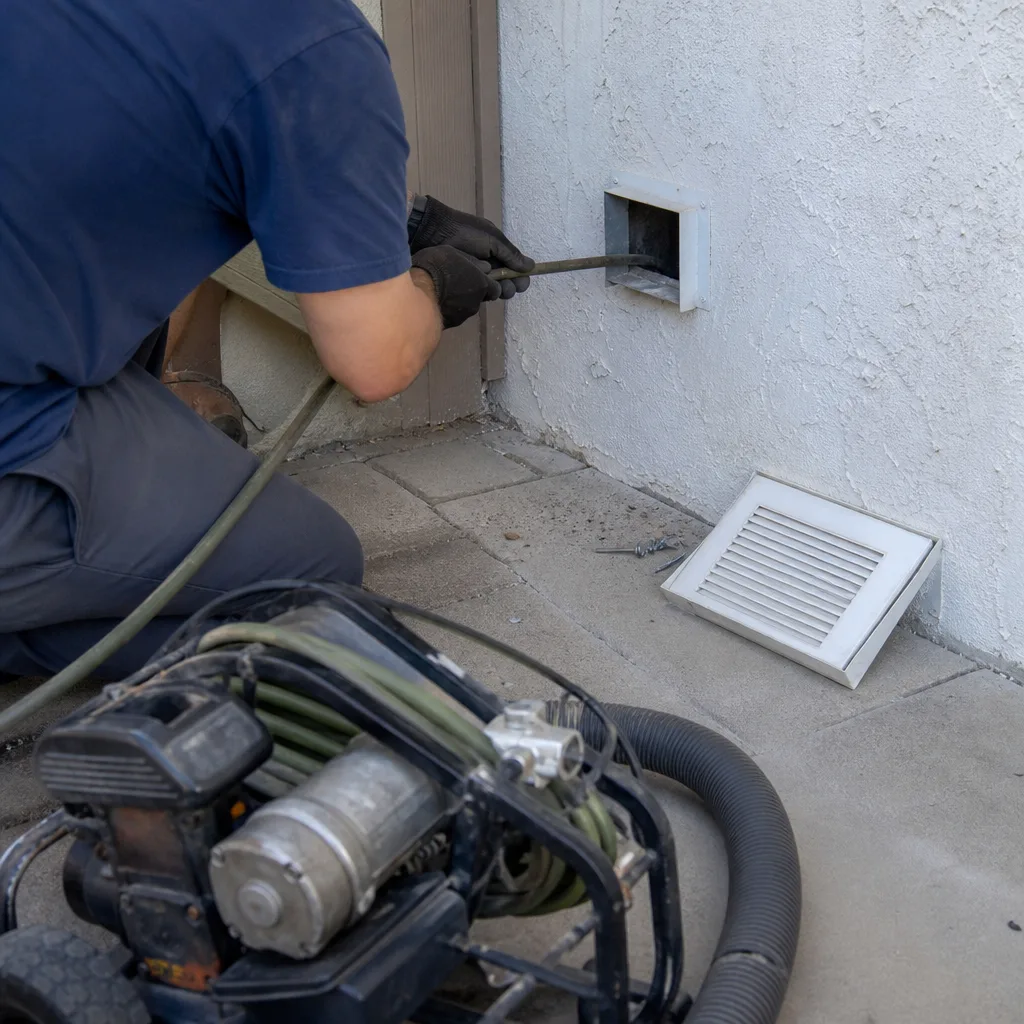
Professional air duct cleaning relies on two primary tools that do different jobs, and understanding the difference explains most of the price gap between a $200 “coupon cleaning” and a real job. The first is a negative-air machine – essentially a massive vacuum connected to the duct system at one point, creating continuous suction throughout the entire network while a technician works. These units from manufacturers like Nikro and Abatement Technologies move 2,000 – 5,000 CFM, enough to pull air through even the longest branch lines in a Pasadena home.
The second is agitation equipment. Negative air alone removes loose debris; most contamination requires mechanical action to dislodge. Rotary brush systems – like the ones Rotobrush manufactures – run a rotating bristle head through the duct interior, scrubbing the walls while the negative-air machine simultaneously captures what comes loose. This is the standard commercial method used in hospitals, schools, and office buildings, and it’s the same approach professional residential crews use in Pasadena homes.
Here’s what each piece of equipment does for the homeowner in plain terms:
| Equipment | What It Does | Why It Matters for Your Home |
|---|---|---|
| Negative-Air Machine (2,000 – 5,000 CFM) | Seals to the duct system and creates continuous suction throughout the entire network | Captures dislodged dust at the source instead of pushing it into living spaces |
| Rotary Brush System (Rotobrush) | Drives a rotating bristle head through trunk and branch lines to scrub adhered dust from walls | Removes the adhered layer that shop vacs and blowing methods miss |
| HEPA Filtration | Filters exhaust air to 99.97% at 0.3 microns on the negative-air machine | Prevents cleaned dust from re-entering attic or living space air |
| Access Ports | Small sealed openings cut into trunk lines to insert brush and inspection tools | Allows full-length cleaning without disassembling ductwork |
The reason this equipment matters isn’t that it’s impressive – it’s that it’s the only way to reach and clean the 85% of your duct system that sits beyond arm’s reach. Without it, you’re paying for a partial job dressed up as a complete one.
One more thing worth saying plainly: the machines are expensive. A proper truck-mounted or portable negative-air unit runs $5,000 – $15,000 new. A quality rotary brush system adds another $8,000 – $20,000. That’s why the true cost of professional duct cleaning sits where it does, and why the $99 specials you see on postcards almost always mean someone is cutting corners somewhere. There’s no version of this work that costs $99 with real equipment, real technicians, and real results.
Honest Cost Comparison: DIY vs Professional in Pasadena
Let’s put real numbers on the table. DIY duct cleaning costs whatever you spend on supplies – a shop vac if you don’t already own one ($40 – $120), a brush kit with flexible extensions ($25 – $50), microfiber cloths and cleaning solution ($15 – $25). That’s $80 – $195 upfront, and it covers the register-level work described above. You can repeat it as often as you like at no additional cost.
Professional air duct cleaning in Pasadena typically falls in these ranges at the time of writing:
| Home Size | Typical Duct Count | Professional Cleaning Range | What That Price Includes |
|---|---|---|---|
| Under 1,200 sq ft (condo, smaller bungalow) | 6 – 10 registers | $350 – $550 | Full trunk and branch cleaning, return side, registers reattached |
| 1,200 – 2,000 sq ft (typical Pasadena ranch or craftsman) | 10 – 16 registers | $450 – $700 | Full system cleaning including main trunk, branches, plenums, registers |
| 2,000 – 3,000 sq ft (larger foothill or San Rafael home) | 16 – 22 registers | $600 – $900 | Full system, longer trunk lines, often two systems or zoned setup |
| 3,000+ sq ft (multi-zone, west Pasadena or La Cañada-adjacent) | 22+ registers | $800 – $1,200 | Multi-system home, extended timelines, sometimes two technicians |
These are whole-system prices – one flat number per job, not per vent. Be wary of anyone quoting per-vent in Pasadena. It’s the classic bait-and-switch structure: a low “per vent” figure that balloons once the technician counts 14 vents instead of the 6 you assumed. A legitimate company quotes the full system as one price before work starts.
Now the honest tradeoff. DIY costs $80 – $195 and buys you register-level cleanliness – visibly cleaner covers, less dust around openings, a sense of control. Professional cleaning costs $400 – $900 (more for large homes) and cleans the entire system: trunk lines, branches, return side, plenums, the parts you can’t see and can’t reach. Whether that professional cost is worth it depends on your home’s specific situation, which the next two sections address directly.
When DIY Is Genuinely Enough
There are real scenarios where a homeowner’s own effort is all the situation requires. Recognizing these keeps you from paying for work you don’t need, and that’s as important as knowing when to hire. Here’s when DIY register cleaning alone is genuinely sufficient:
- Your home is under 5 years old. Newer construction in Pasadena – think recent builds in neighborhoods like Orange Heights or the newer condos along Colorado Boulevard – typically has clean ductwork unless there was a construction-dust issue or the system ran during renovation work.
- You’ve had professional cleaning within the last 2 years and you’ve maintained your filter changes since. Ducts don’t re-contaminate in months if the filter barrier is doing its job. Register maintenance between cleanings is all that’s needed in this window.
- You rent and your landlord is responsible for system maintenance. Your concern is visible dust at registers, not the long-term health of the owner’s ductwork. Register cleaning is appropriate and low-risk.
- You’re selling a home and want registers to look clean for showings. This is about appearance, not air quality, and DIY handles it completely.
- Your budget is genuinely tight and your system is functioning fine. Registers stay clean, airflow is strong, allergies aren’t flaring. There’s no shame in deferring professional cleaning when there’s no evidence it’s needed.
None of these scenarios indicate a system-level problem. They indicate surfaces – and surfaces are what a homeowner can clean effectively. Pasadena’s dry, dusty summers do push more particulate into the first few feet of ductwork than wetter climates, but that doesn’t change what’s reachable versus what isn’t. The reachable part responds to elbow grease. The unreachable part requires equipment.
A note on Hollis Air Duct Pasadena home service philosophy that applies here: we’ve told homeowners to hold off on professional cleaning before. If your ducts are clean and your registers are maintained, you don’t owe us a service call. The job is what it is, and the price is the price, and helping you know the difference between “needs cleaning” and “doesn’t” is part of earning the call when it actually does.
When DIY Makes the Problem Worse
There’s a specific set of circumstances where attempting DIY duct cleaning creates problems that cost more to fix than the professional service would have cost in the first place. If you’re in any of these situations, put down the shop vac and think twice:
- Visible mold growth on register covers or inside the first few inches of duct. In Pasadena’s older homes – especially bungalows with original pier-and-beam foundations in neighborhoods like Bungalow Heaven or Garfield Heights – moisture from crawl spaces creates the conditions mold needs. Wiping visible surface mold sends spores airborne and into the duct system. This is not a register-cleaning situation; it requires assessment and remediation, not elbow grease.
- Rodent or pest activity in the ductwork. The foothill neighborhoods like Hastings Ranch and the San Rafael Hills see more rodent pressure than flatter parts of Pasadena. Droppings and nesting material inside ducts are a health issue, not a dust issue. Attempting to vacuum them without proper containment spreads particulate throughout the home.
- Flex duct that’s become disconnected or crushed. If rooms aren’t getting airflow and you suspect a connection has come loose, reaching into a register with a brush can make the disconnection worse. This needs a professional inspection with a camera scope, not a brush kit.
- Fiberglass duct board starting to deteriorate. Some 1970s – 1990s Pasadena homes used fiberglass duct board for trunk lines. Aggressive brushing on deteriorating fiberglass releases particles into the air stream. A professional can identify whether the material is stable enough to clean.
- Your home had water intrusion or flooding in the duct area. Recent storms or a leaking roof into the attic means moisture inside ductwork. Cleaning without drying first, and without checking for contamination type, can seal the problem in rather than solve it.
- Any situation involving gas furnaces with combustion chambers near the duct system. If you smell gas or suspect any combustion-related airflow issue, stop and call a professional immediately. This is a safety issue, not a cleaning issue.
All of these situations share one trait: the problem isn’t dust. It’s contamination, structural damage, or moisture – all of which require diagnosis before any cleaning happens. If you’re not sure whether your situation is routine or serious, most reputable Air Duct Cleaning in Pasadena companies will assess it without charging you for a full job.
The Combined Approach: DIY Between Professional Cleanings
Here’s the part most guides skip entirely. If you’ve had your ducts professionally cleaned – or you’re planning to – you can extend the interval between professional visits from a typical 3 years to 4 – 5 years with consistent register-level maintenance. That’s real money saved over the lifespan of a home without sacrificing air quality in between.
The combined approach works like this:
- Get a professional baseline cleaning to establish a clean system. If your ducts have never been professionally cleaned and your home is 15+ years old, this is the starting point. No amount of register maintenance makes dirty trunk lines clean.
- Change your HVAC filter on schedule – every 90 days for standard 1-inch filters, more often if you use high-MERV filtration from brands like Honeywell or have pets. This is the single highest-impact maintenance habit for keeping ducts clean between professional visits.
- Clean registers and visible duct openings every 6 months using the method in this guide. Spring and fall work best in Pasadena, keeping the Santa Ana season’s dust and summer’s attic heat cycles from building up at the register level.
- Watch for signs that professional cleaning is needed again: visible dust puffing from registers when the system kicks on, reduced airflow in rooms that used to heat and cool evenly, unexplained allergy symptoms that worsen when the AC runs, or visible debris at register openings within weeks of DIY cleaning.
- Schedule professional cleaning when those signs appear, not on an arbitrary calendar schedule. Some Pasadena homes need it every 3 years; others with good filtration and regular register maintenance can go 5 – 6 years between professional visits.
This approach respects the physical reality of duct systems: register-level maintenance is within homeowner reach and genuinely matters, but it’s not a substitute for equipment-based cleaning of the parts you can’t reach. Doing both, on different schedules, is the most cost-effective way to manage indoor air quality in a Pasadena home.
One related service worth understanding: Duct Sealing in Pasadena. The same attic heat cycles that bond dust to duct interiors also degrade tape and mastic seals over time. When seals leak, your system pulls attic air – hot, dusty, unfiltered – directly into the supply side. Sealing those leaks means less dust entering the system in the first place, which extends the effectiveness of both professional cleanings and your DIY maintenance in between.
Common Mistakes to Avoid
- Using a leaf blower instead of a vacuum. Some YouTube videos recommend pressurizing the system with a blower to push dust out. What actually happens: dust goes deeper into branch lines, out into living spaces, or into the attic through leak points. Pasadena attics are hot and dusty already; you don’t need to add your ductwork’s contents to that environment.
- Removing register covers and forgetting to reattach them properly. Loose registers rattle, leak conditioned air, and create dust entry points. It’s the most common DIY mistake we see in Pasadena homes, and honestly, it’s the easiest one to avoid.
- Using chemical cleaners or sanitizers inside ductwork. Spraying bleach, household cleaners, or “duct freshener” products into your system puts chemicals directly into your breathing air. Some of these products interact badly with metal duct interiors and fiberglass insulation. If duct sanitization is warranted, it should be done with the right products and the right equipment, not a spray bottle from the hardware aisle.
- Assuming visible register dust means the whole system is dirty. Register dust is a surface condition. Trunk-line contamination is a system condition. They don’t always correlate. Before spending money on professional cleaning, check whether your symptoms (allergies, dust on furniture, uneven airflow) match what you’re seeing. A homeowner who cleans their registers twice a year may have clean registers and still need professional service for the trunk lines.
- Failing to check the return air side. Most DIY attention goes to supply registers because they’re visible in every room. But the return side pulls unfiltered air from living spaces into the system. If your return grille is dusty, that dust is actively being drawn through your system. Return-side maintenance is as important as supply-side, and most homeowners miss it completely.
- Attempting to cut access ports into your own ductwork. This is where DIY becomes genuinely dangerous. Cutting into a metal trunk line without knowing where supports, wiring, or other systems run risks damage that costs far more than professional cleaning. If your trunk line is inaccessible and needs cleaning, the access points are part of the professional job. Never attempt this yourself.
- Trusting per-vent pricing as a comparison tool. Some Pasadena-area companies still quote per-vent rates. It’s an apples-to-oranges comparison strategy that almost always ends with a higher final invoice than the whole-system price you were originally comparing against. Ask for one written price for the entire system, period.
When to Call a Professional
Call a professional air duct cleaner when: your home is over 10 years old and the ducts have never been cleaned; you see dust puffing from registers when the system starts; rooms heat or cool unevenly despite a functioning HVAC; allergies or respiratory symptoms worsen specifically when the AC or heat runs; you’ve had renovation work that generated drywall dust or construction debris; you smell musty odors when the system kicks on; or you’ve found evidence of pest activity near or in your ductwork. These are system-level conditions, not register-level conditions, and they require equipment, inspection, and experience to address properly. If you’re ready to hire, read our How to Hire a Air Duct Cleaning Contractor in Pasadena: A Step-by-Step Guide first.
Hollis Air Duct Pasadena offers free estimates throughout Pasadena – call (626) 469-5477 and we’ll assess your system honestly, tell you whether cleaning is needed now or can wait, and give you a written price before any work starts.
Frequently Asked Questions
Professional air duct cleaning in Pasadena typically costs $400 – $900 for a whole-home system, depending on square footage, number of registers, and system configuration. Smaller condos and bungalows fall in the $350 – $550 range; larger foothill homes with multiple systems can reach $1,200. Be wary of per-vent pricing or quotes under $200 – they almost always mean partial cleaning or upsells at the door. Call (626) 469-5477 for an exact written quote on your home.
You can effectively clean what you can reach – registers, grilles, and the first 12 – 24 inches of visible ductwork – which accounts for about 15% of a typical system. The main trunk lines, branch lines, and return plenum require negative-air machines and rotary brush systems that cost thousands of dollars and aren’t practical for homeowner use. DIY maintenance between professional cleanings is valuable; DIY as a substitute for professional cleaning leaves 85% of the system untouched.
Most Pasadena homes need professional duct cleaning every 3 – 5 years, depending on filter habits, pets, home age, and whether the attic or crawl space contributes dust to the system. Homes with good filtration, sealed ducts, and consistent register maintenance can extend to 5 – 6 years. Homes with renovation history, water intrusion, or years of missed filter changes may need it sooner. The best signal is inspection – visible dust at registers within weeks of cleaning, or a dusty film returning quickly, indicates the system needs attention.
Cheaper quotes usually mean one of three things: the company is quoting a per-vent or per-register price that will multiply once they’re in the house; they’re doing a “blow and go” job with no negative-air containment; or they’re using the low price as a loss leader to find upsell opportunities during the visit. In Pasadena’s market, legitimate whole-system cleaning with real equipment costs what it costs because the machines, insurance, background checks, and technician time represent real expense. If a price seems too low to support that overhead, it probably doesn’t.
Ask for before-and-after photos from inside your ductwork. Reputable companies document the condition of trunk lines before and after cleaning using camera scopes, and these photos are yours to keep. A company that can’t or won’t show you the inside of your ducts before and after hasn’t actually verified the work. Every professional cleaning should also include a walkthrough of the equipment used and an explanation of what was found and what was done.
Yes, though the payoff depends on your home’s age and condition. Pasadena’s hot, dry summers and seasonal Santa Ana winds push particulates into homes at higher rates than coastal communities, and the extreme attic temperatures degrade duct seals faster, pulling unfiltered attic air into systems. Homes in neighborhoods like Hastings Ranch and the San Rafael Hills – which sit closer to open hillside and wildfire exposure – tend to accumulate particulates faster than lower-lying central Pasadena homes. If you’re seeing dust or experiencing respiratory symptoms tied to HVAC operation, professional cleaning is worth pursuing.
The Bottom Line
DIY air duct cleaning is a legitimate maintenance practice with real value – but it operates at the register level, cleaning the visible surfaces you can reach with a brush and a shop vac. Professional cleaning operates at the system level, using negative-air machines and rotary brush systems to clean the 85% of your ductwork that sits beyond homeowner reach. The smart Pasadena homeowner does both: register maintenance every 6 months, professional cleaning when system-level signs appear, and honest assessment in between. That’s how you spend money where it matters, and why the “$99 special” is almost always neither special nor complete. Browse more guides & resources on maintaining healthy indoor air.
Written by Roy Castellanos, Owner at Hollis Air Duct Pasadena, serving Pasadena since 2004.
See the difference
 Before
 After
After Before
 After
After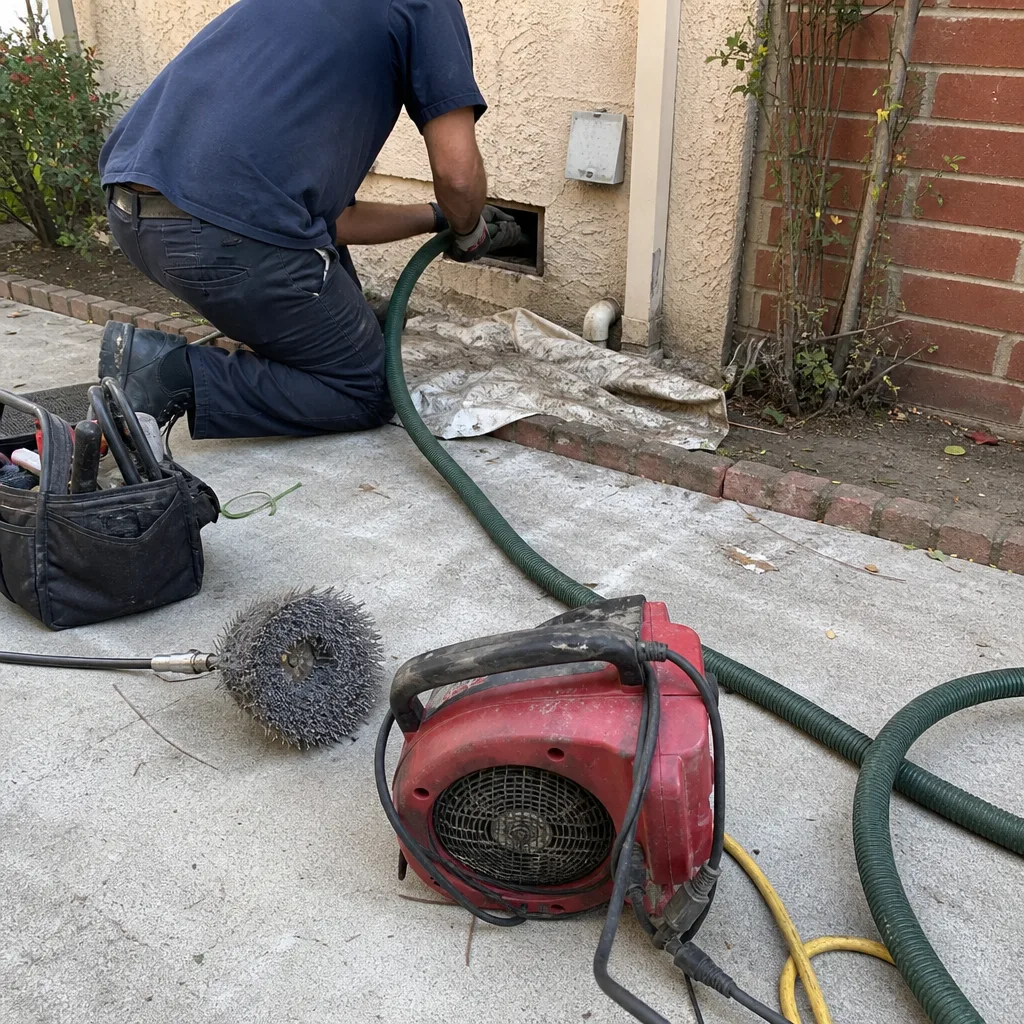 Before
 After
After