
Last updated October 15, 2026
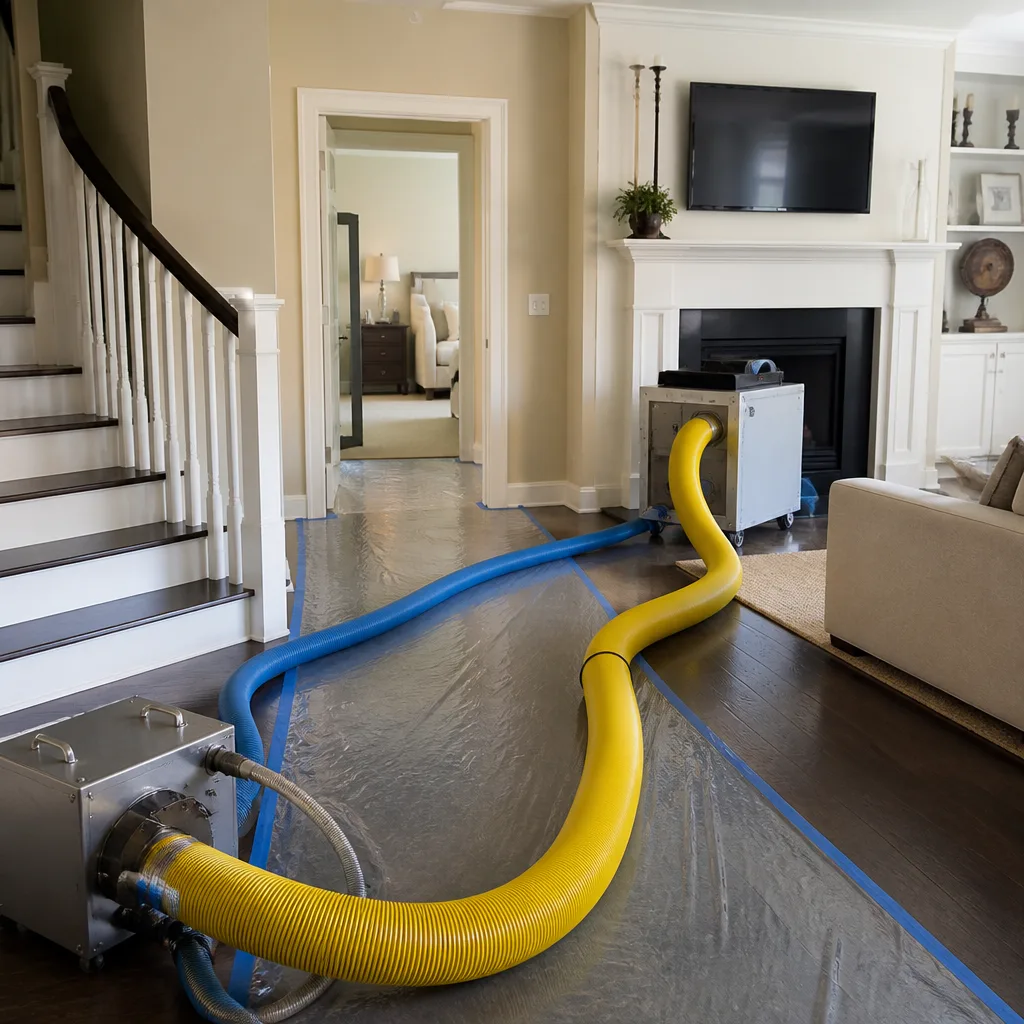 Whole-home duct cleaning
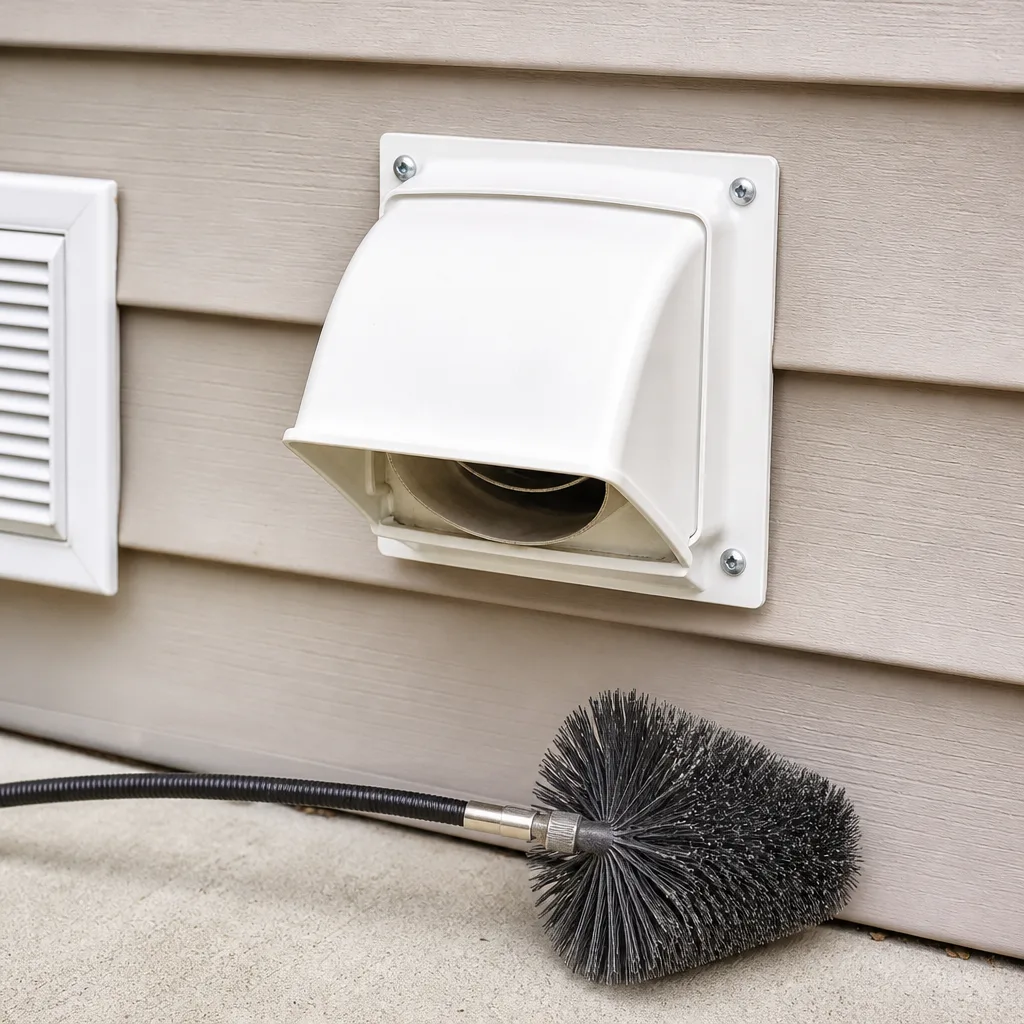 Dryer vent cleaning
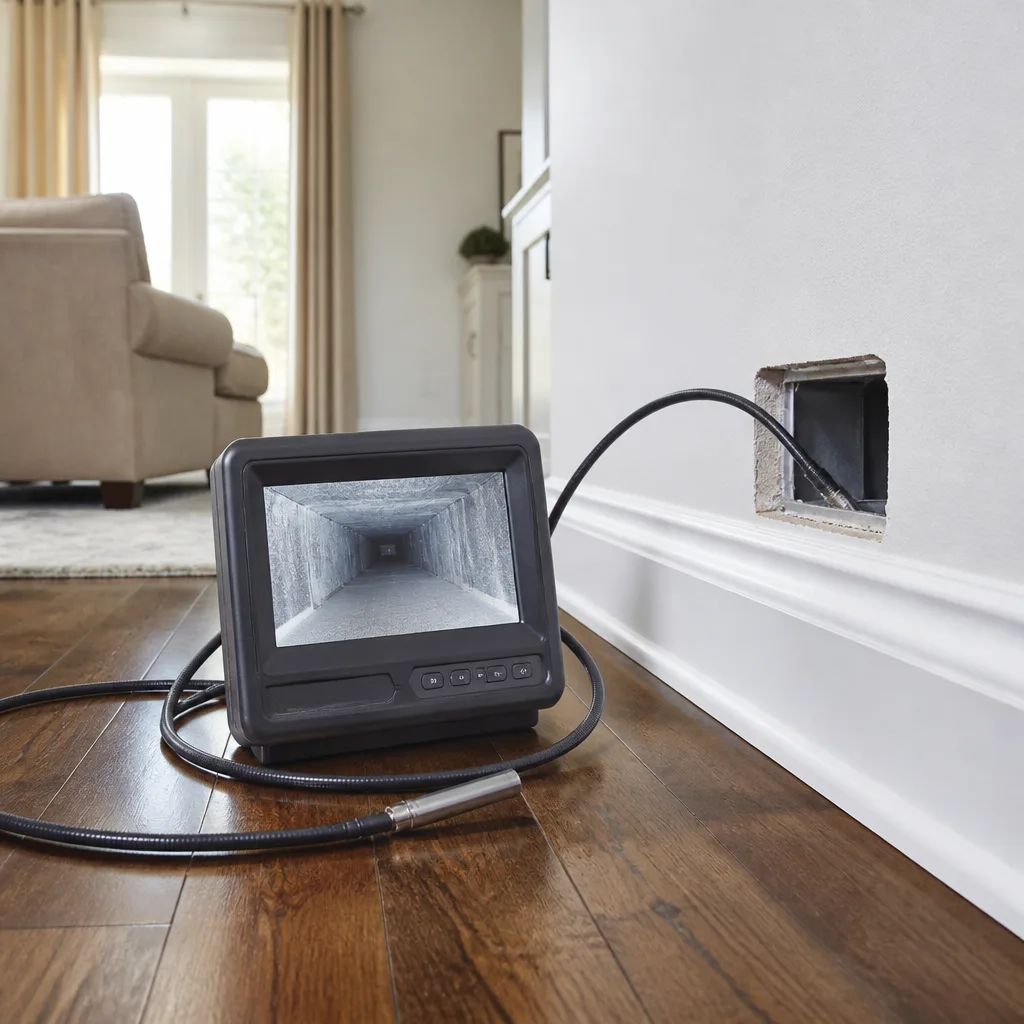 Camera inspection
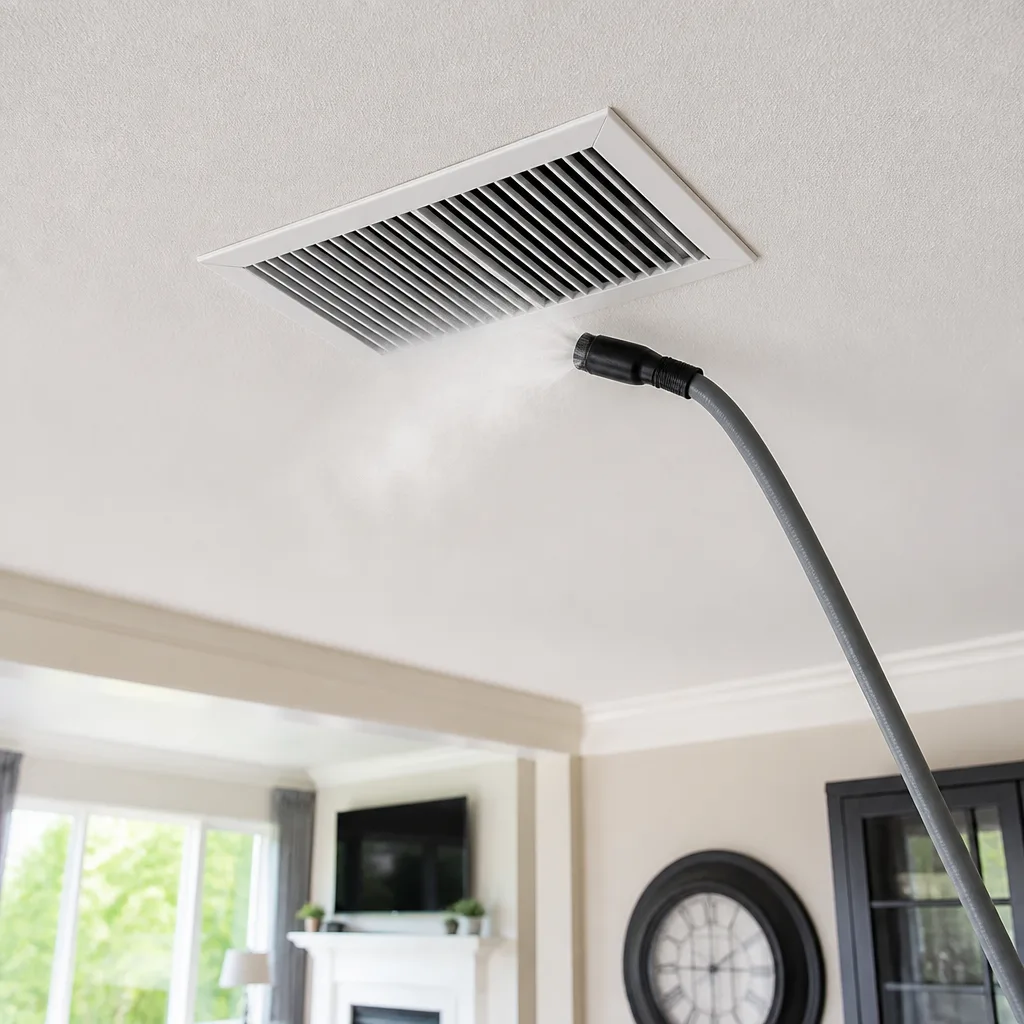 Sanitizing & deodorizing
Whole-system duct and dryer vent check with before-and-after photos - you see exactly what came out of your vents
That "$99 whole-house special" is a bait ad - the real number appears once they are in your hallway, or the "clean" is a shop-vac at the register. We photograph the inside of your ducts before and after instead.
Seasonal Air Duct Cleaning Care for Pasadena: Year-Round Homeowner’s Guide
Pasadena recorded 47 days above the federal PM2.5 health threshold in a recent year. Every one of those days pushed fine particulates through your return ducts, and most homeowners never connect those air quality alerts to the dust now sitting inside their walls. This guide gives you a season-by-season maintenance calendar built around what actually happens to a Pasadena duct system, from Santa Ana wind events to wildfire smoke to spring pollen load. You’ll learn what to inspect, when to clean, and how to read AQMD data so you’re not guessing.
Quick Answer
Seasonal Air Duct Cleaning services in Pasadena means scheduling professional cleaning twice a year: once after Santa Ana wind season winds down in early spring, and again after wildfire smoke season ends in late fall. Between cleanings, homeowners should replace filters monthly during high-dust periods, inspect return registers after every major wind event, and run the system on fan-only mode for 20 minutes after smoke clears. A typical whole-home duct cleaning in Pasadena costs $350 to $650 depending on system size and the number of returns.
Styles & brands we work with
Table of Contents
- Santa Ana Wind Season: Your Ducts’ Hardest Months
- Wildfire Smoke Protocol: Before, During, and After an AQ Event
- Spring Pollen Season: The Allergen Load Problem
- Summer Preparation: Airflow Before Peak Cooling Demand
- How to Build a 12-Month Duct Care Calendar Using AQMD Data
- What Duct Cleaning Costs in Pasadena and Why Prices Differ
- DIY Inspection Checklist: What You Can Safely Check Between Cleanings
Santa Ana Wind Season: Your Ducts’ Hardest Months
Santa Ana winds in Pasadena run from October through March, and they are the single biggest driver of duct contamination in this region. These winds don’t just move air; they move fine desert dust, ash from previous fire seasons, and construction particulate from the foothills, and they push it against every exterior surface of your home, including the fresh-air intake and any gaps around exterior doors and windows. When your system runs, that suspended particulate gets pulled through return registers. The air filter catches some of it. The rest settles in the return ductwork, where it builds up month after month.
Here’s what we’ve seen in Pasadena homes after a major Santa Ana event: return ducts in older homes near the Arroyo Seco corridor can accumulate visible dust in as little as 60 days. Homes in the foothills above the 210 freeway tend to see even faster accumulation because wind speed increases with elevation and soil in those areas is drier and finer. The return side matters more than the supply side here. Return ducts pull unconditioned air from the living space back to the air handler, which means any particulate that enters the home through a door, window, or fresh-air vent gets pulled into the returns before it ever reaches a filter. In our experience, many Pasadena homes have their first real return-duct inspection only when someone in the household develops unexplained sinus issues.
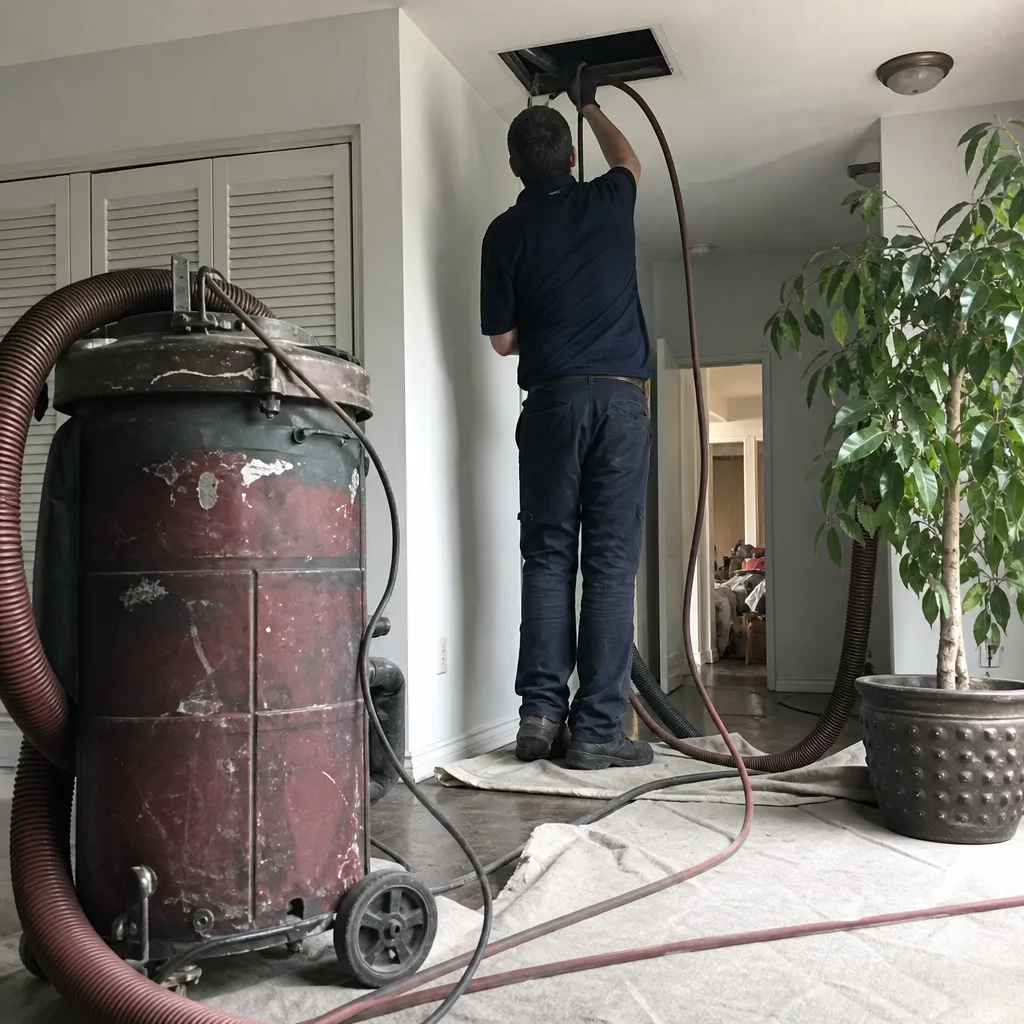
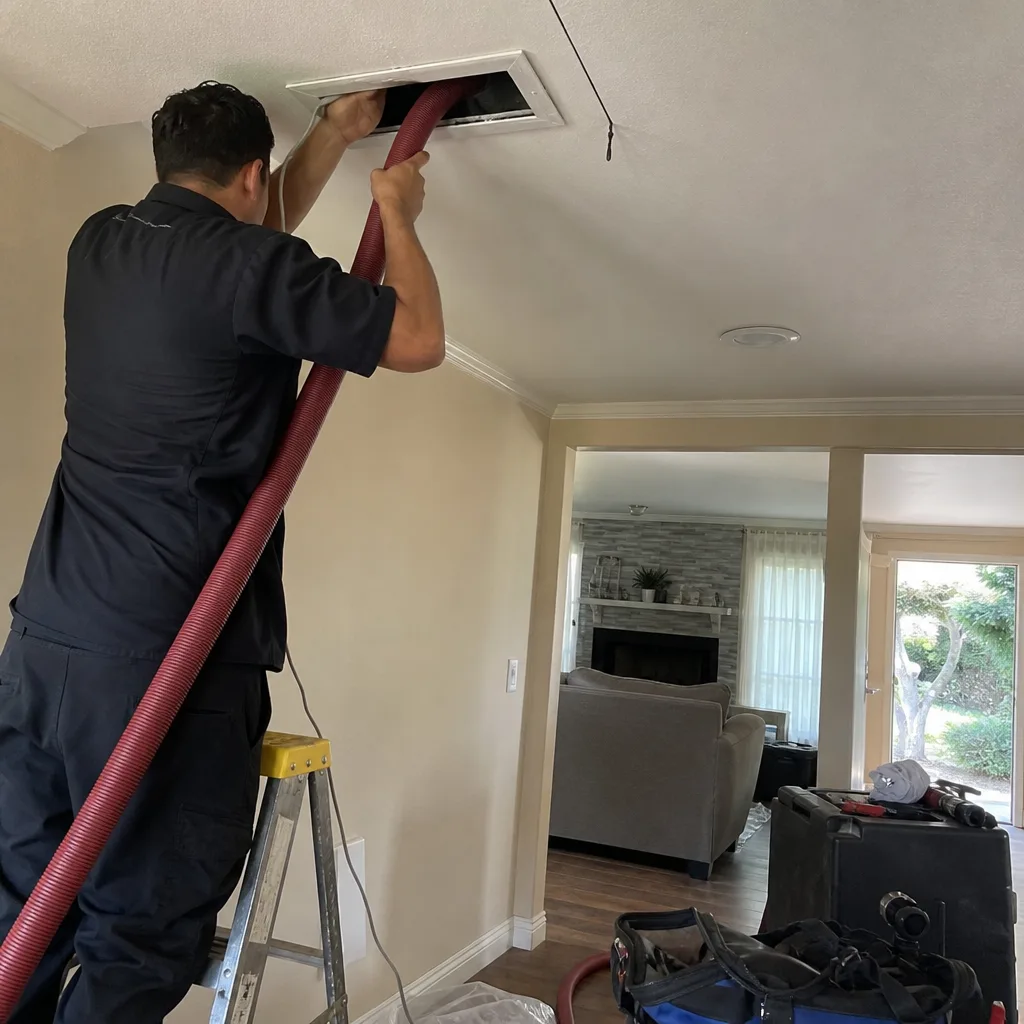
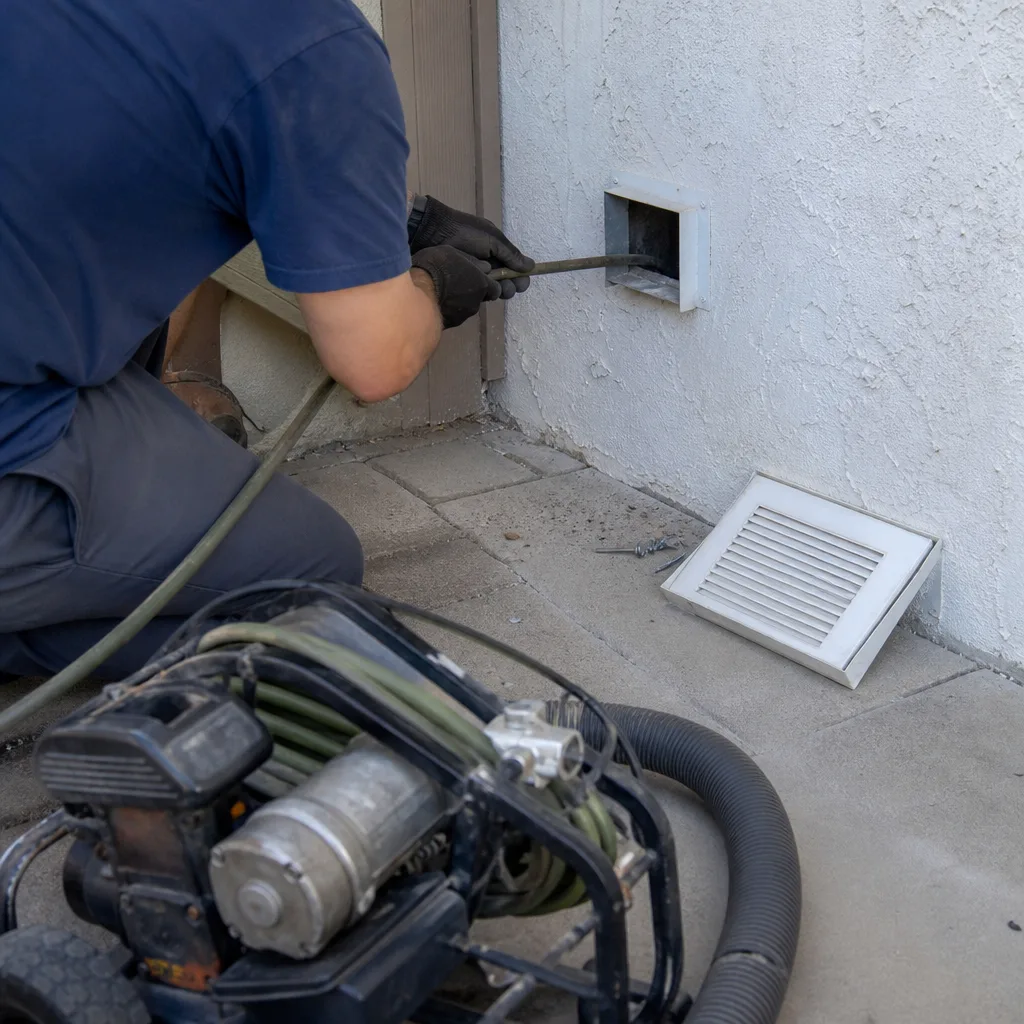
The key Santa Ana season practice: check your return registers visually after every wind event over 30 mph. If you can swipe a white cloth across the inside of the register and come away with visible dust, the return duct behind that register is carrying loose particulate. A professional air duct cleaning in Pasadena using a negative-air machine recovers that dust rather than redistributing it. Negative air means the machine pulls air through the duct into a contained filtration system, not back into your living space. This is the industry standard for a reason.
Wildfire Smoke Protocol: Before, During, and After an AQ Event
Pasadena sits downwind of multiple wildfire zones, including the Angeles National Forest and the San Gabriel Mountains foothills. When smoke settles into the San Gabriel Valley, it doesn’t just sit outside. It gets pulled into HVAC systems through the fresh-air intake and through the building envelope, and it leaves a residue that standard fiberglass filters cannot fully capture. Smoke particulate is fine enough to penetrate most residential filter media and it carries volatile organic compounds that can linger in ductwork for months after the outdoor air clears.
Here is a step-by-step protocol for handling your system during and after a smoke event in Pasadena:
- During the event: Set your system fan to “ON” rather than “AUTO,” keep windows shut, and confirm your filter is at least MERV 11. If you have a fresh-air damper, close it. Running the fan continuously keeps air moving through the filter rather than allowing particulates to settle.
- Upgrade temporarily: During smoke events, swap your standard filter for a MERV 13 filter rated for the unit. Check the filter manufacturer’s pressure-drop spec; some older air handlers can’t pull through a MERV 13 without losing airflow. Homeowners with Aprilaire media cabinets have an easier upgrade path, but confirm compatibility with a technician.
- After the smoke clears: Run the fan on “ON” for 30 to 45 minutes before you re-open windows. This pulls remaining suspended particulate into the filter.
- Two to three weeks after air quality returns to AQMD “Good” range: Have the return side of your duct system inspected. Smoke residue clings to dust already inside the ductwork, creating a heavier, stickier layer that standard cleaning alone won’t fully remove. In our experience, homes that skip this post-smoke inspection end up with a stale smoke odor that returns every time the system cycles for the next year.
The trigger for scheduling a professional cleaning after smoke season: if you can still smell a faint smoke note when the system kicks on, two weeks after the outdoor air cleared, the residue is inside your ductwork, not outside. We use negative-air machines from Nikro to pull contaminants out of the system while it is sealed, and rotary brush tools from Rotobrush when the buildup is heavy. Neither tool works well without the other on smoke-contaminated systems.
Spring Pollen Season: The Allergen Load Problem
Pasadena’s spring flowering season starts earlier than most of the country, often by late February, and the pollen types that dominate here, oak, sycamore, and cedar from the San Gabriels, produce a heavier, stickier particulate than the dry dust of Santa Ana season. Pollen finds its way into ductwork primarily through open windows and doors during the mild weeks before cooling season starts. Once inside the return ducts, pollen clings to dust layers and dries out. When cooling season begins, that dried pollen can cycle back into living spaces every time the blower runs.
Here’s what matters during spring in Pasadena:
- Window operation matters more than people think. The weeks between late February and mid-April are the highest pollen-release period in the San Gabriel Valley. Open-window ventilation during this window guarantees pollen entry into return ducts. Close windows on high-pollen days and run the fan on ON with a clean filter instead.
- Return duct interiors are the critical inspection point in early spring. If a homeowner in Pasadena has never had their return ducts inspected, early spring is the right time. Debris from Santa Ana season is still in the system, pollen is being added to it, and the combined layer is exactly what feeds dust mites and mold spores once temperatures rise.
- Coil and blower inspection should happen in the same visit. A duct cleaning that ignores the blower wheel and evaporator coil leaves the two components that come into direct contact with the air stream. In spring, we regularly find blower wheels in Pasadena homes coated with a dark film of pollen, dust, and smoke residue from the prior winter.
Homes in the Bungalow Heaven and Madison Heights neighborhoods, with their older floor plans and narrower return duct sizing, tend to show the most dramatic build-up in the spring. The air handler works harder to pull air through smaller returns, which creates higher air velocity and more particulate settling on smaller surface areas. A professional duct sealing service in Pasadena can reduce the leakage that draws attic and crawlspace particulate into the system, which is the second-largest source of spring contamination.
Summer Preparation: Airflow Before Peak Cooling Demand
Pasadena summers run hot and dry, with July and August regularly hitting the high 90s and dry heat driving heavy air conditioning use. The single biggest summer performance problem in Pasadena homes isn’t the AC unit; it’s airflow restriction from clogged coils, dirty blower wheels, and collapsed or leaking ducts. When airflow falls, the system runs longer to reach setpoint, which means higher utility bills and more wear on the compressor. According to our own seasonal walkthroughs, a Pasadena home with dirty returns and a restricted coil can lose 10 to 15 percent of total airflow, and the system compensates by running longer cycles.
Here is a summer preparation checklist, in the order that matters for a Pasadena home:
- Inspect the filter housing and replace the filter at the start of June. A filter loaded with spring pollen forces the blower to work harder. Use a MERV 8 to MERV 11 for summer; higher isn’t always better on older single-speed blowers.
- Visually inspect every supply register for dust streaks. Streaks are a sign of duct leakage pulling attic heat and particulate into the supply side.
- Check the blower wheel for dust film. This requires access to the air handler, which is where a professional inspection pays for itself. A coated blower wheel can cut airflow by 20 percent and you won’t fix it with a filter change.
- Confirm the condensate drain line is clear. Pasadena’s dry climate means homeowners often forget this step, but a clogged drain during a high-demand week can overflow, shut down the system at the worst possible time.
- Set the thermostat to run the fan in ON mode during the first week of July. This pushes any remaining loose particulate through the filter before peak cooling hours force the system into continuous auto cycling.
If your air handler is in the attic, as it is in many Pasadena homes built before 1980, attic temperature matters. Attic air in a Pasadena summer can exceed 140 degrees, and supply ducts running through that heat lose temperature before the air reaches your living space. A duct inspection that includes checking for separated joints and missing insulation on the supply side is part of any Hollis Air Duct Pasadena home service walkthrough. The goal is simple: don’t let the cool air you paid to produce leak into an attic before it reaches the room.
How to Build a 12-Month Duct Care Calendar Using AQMD Data
You can build a Pasadena-specific duct care calendar without guessing. The South Coast Air Quality Management District publishes real-time PM2.5 and PM10 data for the San Gabriel Valley, and that data maps directly onto what your ducts are experiencing. The pattern is consistent enough to plan around.
Here is a month-by-month calendar for a typical Pasadena home, organized around the four periods that matter:
- November through February (Santa Ana season): Check return register dust weekly. Replace filters every 30 days regardless of rated life. After any wind event over 30 mph, inspect return grilles within 48 hours. If you see visible dust accumulation on the grille face, flag that return for professional cleaning in spring.
- March through mid-April (pollen season): Close windows on high-pollen days. Run the fan on ON during peak pollen release hours (early morning). Schedule the annual duct inspection and cleaning for late March or early April, before cooling season begins.
- May through September (cooling season): Set the fan to ON for the first week of July. Inspect every supply register for dust streaks once per month. Have the blower wheel and coil inspected if you notice reduced airflow at the registers.
- October through early November (post-wildfire smoke season): After the last significant smoke event of the season, run the fan on ON for two weeks. Then inspect the return side of the system. If smoke odor persists, schedule a post-smoke duct cleaning before the holidays, not after.
The AQMD publishes a “Good / Moderate / Unhealthy” scale for the San Gabriel Valley. Your rule of thumb is straightforward: any day in the “Unhealthy for Sensitive Groups” range or higher means particulate is entering your system. A week of those days means it’s time for a filter check. A month of them, which Pasadena regularly sees during fire season, means it’s time to call a professional. You can also check PurpleAir sensor data for your specific neighborhood, but be aware that consumer sensors read differently from AQMD reference monitors; AQMD data is the standard for planning.
What Duct Cleaning Costs in Pasadena and Why Prices Differ
For a detailed look at what drives these numbers, see our Air Duct Cleaning Cost Breakdown: The Pasadena Homeowner’s Reference for 2026. Whole-home air duct cleaning in Pasadena typically costs between $350 and $650 for a standard single-family home with one air handler and 10 to 14 registers. Homes with two air handlers, or systems with extensive attic duct runs, run higher, usually $650 to $900. A post-smoke cleaning on a system with heavy tar residue can push toward $1,100 because it requires more passes with a rotary brush and longer negative-air dwell time. These are honest ranges, not estimates.
Here is what we commonly see in the Pasadena market:
- Whole-system cleaning (supplies + returns + coil + blower): $450 to $650 for a typical 1,800 to 2,800 square-foot Pasadena home.
- Return-side only cleaning: $200 to $350, and we recommend this only when the supply side was cleaned recently and the issue is isolated, which is rare.
- Post-smoke cleaning with heavy residue: $700 to $1,100 depending on system size and the number of years of accumulated particulate.
- Duct sealing add-on: Priced per project after an inspection, not per vent.
If a Pasadena homeowner is quoted a whole-home duct cleaning for $99 or $149, the math doesn’t work. A crew that shows up at that price is either selling you a partial cleaning (return side only, often just a vacuum attachment), or they are bait-and-switch pricing that turns into $800 once the technician looks at the system. This is the most common complaint we hear from Pasadena homeowners who have used a low-price duct cleaning service before calling us. The work takes time, equipment, and labor. Negative-air machines from Nikro and rotary brush systems from Rotobrush cost money to run and maintain. A price that doesn’t cover that isn’t a price; it’s an opening move.
Our approach at Hollis Air Duct Pasadena is simple: we write the price down before we touch anything. It doesn’t move after we open the first register. The price you agree to is the price on the invoice. It’s covered by the 365-Day Done Right Promise, which means if anything fails within a year, we come back and fix it at no charge, including a free second visit. The promise in writing is the only kind that counts.
DIY Inspection Checklist: What You Can Safely Check Between Cleanings
You don’t need to open up your ductwork between professional cleanings, but there are checks you can do in five minutes with a flashlight and a white cloth. These don’t replace professional cleaning, but they tell you when you need one.
- Return register swipe test: Wipe a white cloth across the inside face of each return grille. If the cloth comes away with visible dust, the return duct behind it is carrying loose particulate. One swipe per return, once a month during Santa Ana season.
- Supply register streak check: Look at the wall or ceiling around each supply register. Gray streaks radiating outward from the register indicate particulate-laden air escaping around the register frame, which usually points to duct leakage at the boot.
- Filter inspection: Hold the filter up to a light source. If you can’t see light through it, it’s loaded. In Pasadena during wind season, that can happen in 30 days on a standard one-inch filter.
- Smell test after cycles: When the system kicks on, stand near a supply register. A dusty, musty, or faint smoke note within the first 30 seconds of airflow means something inside the system is off. It’s not the house; it’s the system.
- Airflow comparison test: Compare the airflow at the register nearest the air handler with the one farthest from it. If the far register feels significantly weaker, you have a duct blockage or leak somewhere in the run.
If any of these checks raise a concern, the next step is a professional inspection. These are not things to fix yourself. Ductwork is under pressure, and the components involved, blower wheels, coils, and sealed duct runs, are not homeowner-serviceable. A safe approach is to document what you found, then make a call and describe it clearly. That gets you an accurate price over the phone and a technician who shows up already knowing where to look.
Common Mistakes to Avoid
- Replacing the filter and calling it done. A filter catches what passes through it. It does nothing for what has already settled in the return ducts behind it. In Pasadena, where Santa Ana winds deposit particulate into returns for months at a time, filter changes are maintenance, not cleaning.
- Waiting for a musty smell before calling a professional. By the time a Pasadena homeowner smells that note from the registers, the contamination layer is thick and set. Smell is a late-stage indicator, not an early one. Pre-scheduled inspections catch the problem before it reaches that point.
- Using consumer-grade cleaning tools from a hardware store. A shop vac attached to a register pulls dust off the first few inches of duct face and does nothing for the remaining 30 feet of run. Worse, it can disturb settled dust and distribute it through the living space.
- Scheduling cleaning for early summer. Pasadena homes need cleaning before cooling season, not during the first heat wave. By the first week of June, a system with dirty returns has already spent two months accumulating spring pollen. June is when you’re fixing what should have been addressed in March.
- Assuming one cleaning per year is enough. In a climate without major wind or fire events, yes. Pasadena isn’t that climate. Homes in this valley routinely need a spring cleaning to address Santa Ana season, and many need a second pass after a heavy smoke season.
- Removing the filter to increase airflow in summer. This is dangerous practice, and it appears more often than you’d think. Running without a filter for even a month lets unfiltered particulate coat the coil and blower wheel. In Pasadena’s dry heat, that layer bakes on quickly through repeated cycles and becomes brittle and hard to remove.
See the difference
 Before
 After
After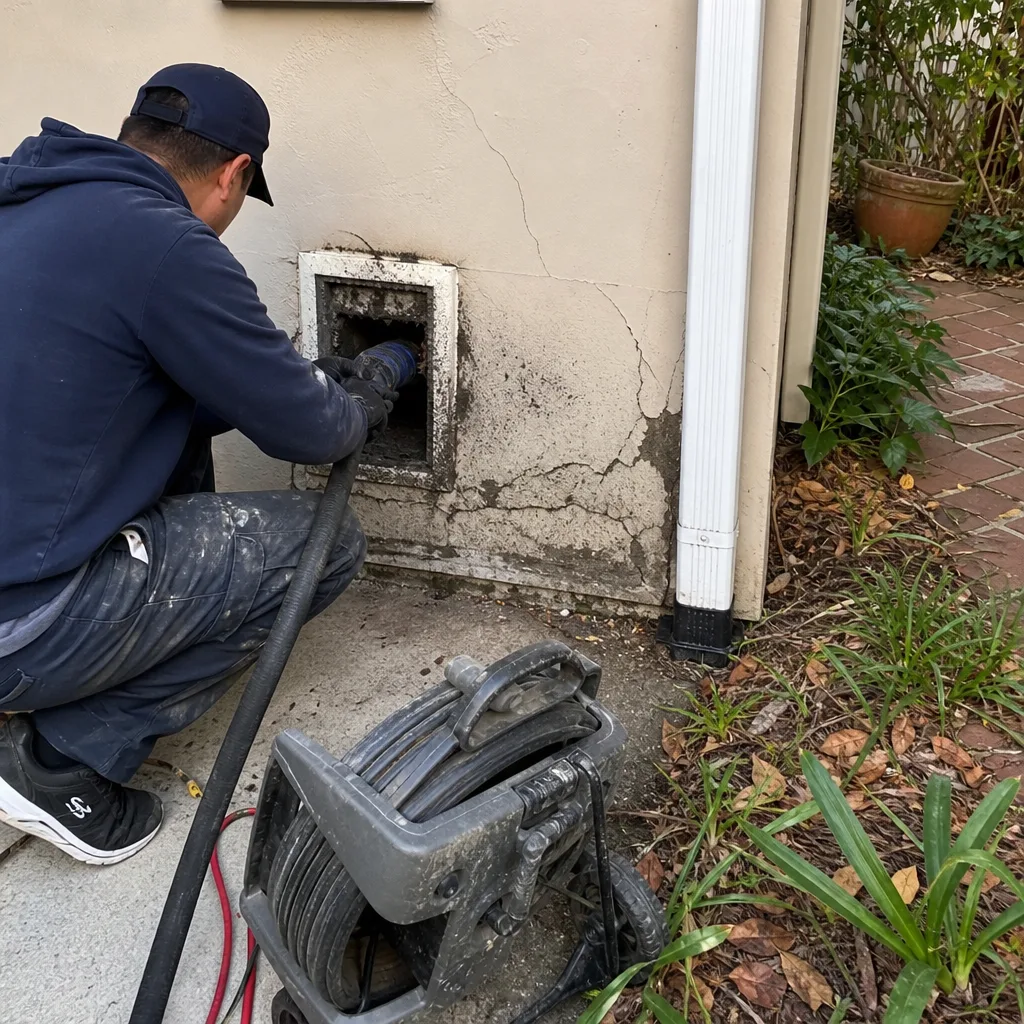 Before
 After
After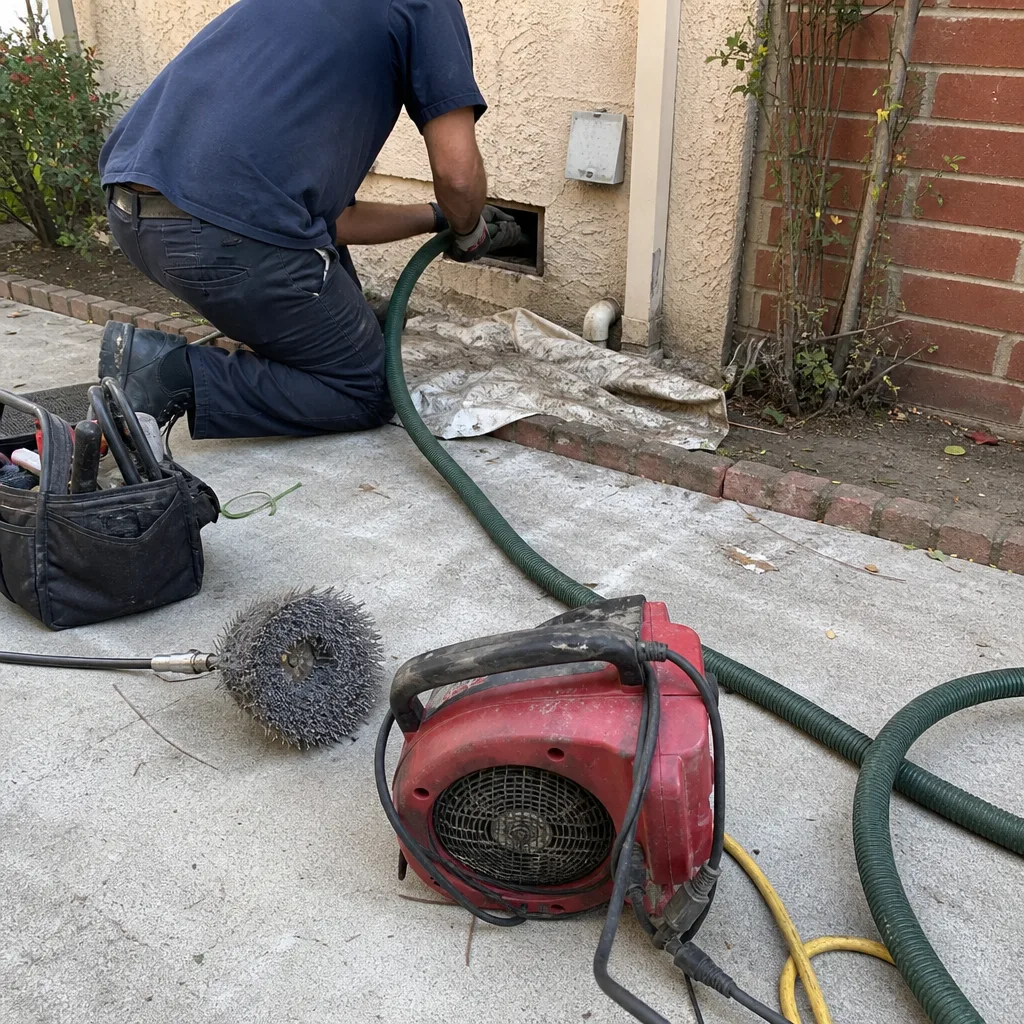 Before
 After
AfterWhen to Call a Professional
Call a professional if you notice any of these: visible dust repeated within 48 hours of cleaning a register, a musty or smoke note from the registers when the system cycles, reduced airflow at far registers compared to near ones, dust streaks around supply registers, or the presence of anyone in the household with worsening allergies or respiratory symptoms that track with system run time. Also call if you’ve never had your ducts professionally inspected and the home is older than 15 years. In Pasadena, that describes a large share of the housing stock, including most homes in the Craftsman-era neighborhoods. A trained technician can get eyes on the blower wheel, coil, and duct interior within an hour and tell you precisely what you’re dealing with. Hollis Air Duct Pasadena offers free estimates in Pasadena. Call (626) 469-5477 and a live person will answer, any time, day or night. There’s no voicemail loop and no callback queue.
Frequently Asked Questions
Air ducts in Pasadena should be professionally cleaned every 12 to 24 months, with the timing tied to the seasonal stress periods. Homes in the foothills or near the Arroyo Seco corridor that experience heavy Santa Ana wind seasons and close wildfire seasons may need cleaning twice a year, once in early spring and again in late fall. A home with one filter change per quarter and no visible dust at the registers can extend to 24 months, but that’s unusual in this climate. Most Pasadena homes with central air and attic duct runs benefit from annual cleaning. Call (626) 469-5477 for an exact quote; estimates are free.
Whole-home air duct cleaning in Pasadena costs $350 to $650 for a standard single-family home with one air handler and 10 to 14 registers. Homes with two air handlers or extensive attic runs cost $650 to $900. Post-smoke cleaning with heavy residue runs $700 to $1,100. If you see a price under $150 for whole-home cleaning, it’s not a whole-home cleaning. Call (626) 469-5477 for a written price before any work starts; estimates are free.
Cheaper duct cleaning quotes usually cover only the return side, use a portable vacuum instead of a negative-air machine, skip the blower wheel and coil entirely, or are a teaser price that expands once the technician is inside your home. A legitimate whole-system cleaning in Pasadena requires professional equipment, which costs money to own and operate. The low price isn’t a discount; it’s a signal that the job definition is smaller than what you think you’re buying. Call (626) 469-5477 to get a written price that covers the full system and doesn’t move at the door.
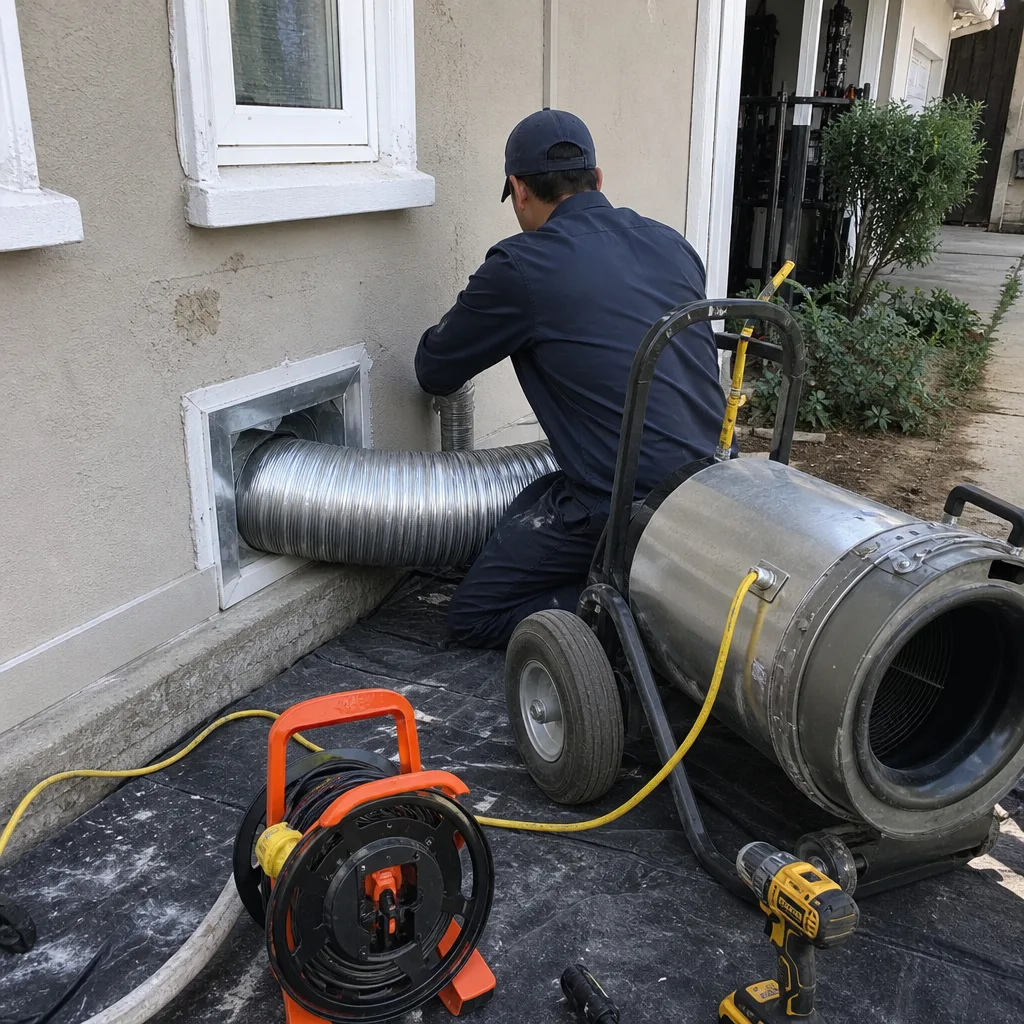
Ask for before-and-after photos or video of the duct interior. A legitimate Pasadena duct cleaning company can show you the return side and supply side before work starts and after the job is complete, including the blower wheel and coil if those were part of the service. Any company that can’t produce visual proof from inside the ducts, not just a photo of their van in your driveway, hasn’t shown you the work. Our technicians document every job with before-and-after images. Call (626) 469-5477 to ask how we do it; estimates are free.
Yes. Wildfire smoke in Pasadena enters through the building envelope, specifically around doors, windows, and any fresh-air intake connected to the HVAC system. Once inside, the system pulls it into the return ducts, where fine particulate settles and bonds with existing dust. Keeping windows closed reduces the load but doesn’t stop it. Homes with a fresh-air damper should close it during smoke events, and all Pasadena homes should run the fan on ON to keep air moving through the filter. After a heavy smoke season, schedule a return-duct inspection even if the outdoor air has cleared. Call (626) 469-5477 to schedule one; estimates are free.
No. The tools that work, negative-air machines and rotary brush systems, are professional equipment that cost thousands of dollars and require training to operate safely. What you can do is the five-minute register swipe test, filter inspection, and visual checks described above. These tell you when you need a professional; they don’t replace one. Attempting to clean ducts with a consumer shop vac pushes dust back into the living space and doesn’t reach the majority of the duct run. Call (626) 469-5477 and we’ll give you a written price for the real thing; estimates are free.
The Bottom Line
Pasadena’s duct systems are under seasonal stress that most regional advice ignores. Santa Ana winds push particulate into returns for five months. Wildfire smoke leaves a residue that lingers for the rest of the year if not addressed. Spring pollen and summer cooling demand finish the job. The solution is a maintenance calendar built around these four periods, not a guess. For more guides & resources, visit our blog. Clean your returns after wind season and after smoke season, replace filters monthly during high-dust months, and get a professional inspection before cooling season starts. If you want the work done by a company that writes the price down before it starts and backs the job in writing for a year, call Hollis Air Duct Pasadena at (626) 469-5477. A live person will answer.
Written by Roy Castellanos, Owner at Hollis Air Duct Pasadena, serving Pasadena since 2004.